

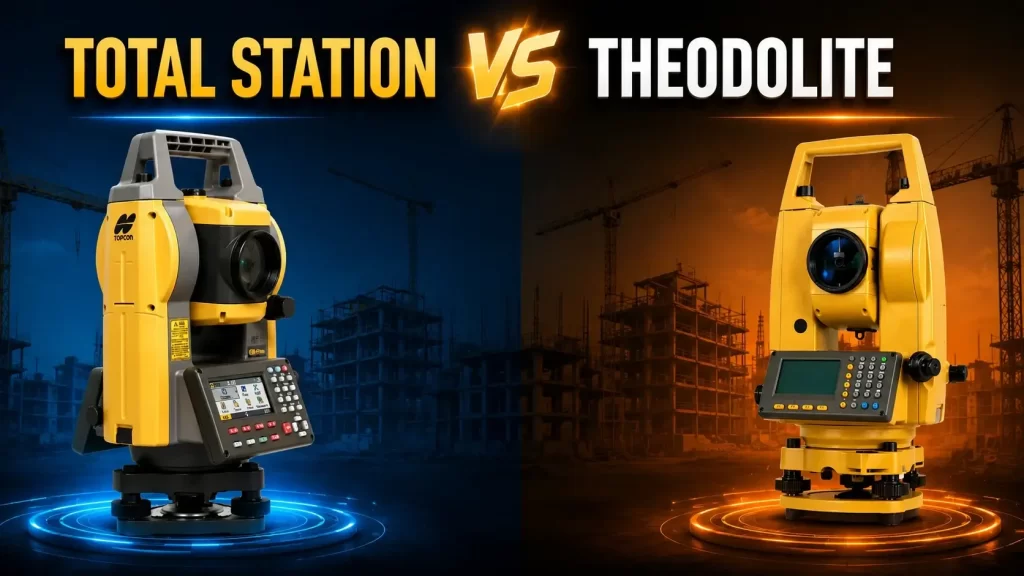
Surveying is the foundation of any successful construction, infrastructure and civil engineering project. Constructing a highway, measuring out the borders of a parcel of land, or designing a building? Success depends on precise measurements. The right surveying tools can help you work much more efficiently and avoid expensive mistakes.
The most common surveying instruments are theodolites and total stations. Both are used to measure angles but they can do very different things . Total Station – Total Station is an electronic instrument used for surveying and building construction that measures angles and distances and automatically calculates the position of points. However, the Theodolite is mainly used to measure horizontal and vertical angles.
This is a complete guide on Total Station vs Theodolite, how they work, the differences, pros and cons, applications and what is the best choice for your surveying needs.
What is a Total Station?
- Electronic Theodolite: Measures both horizontal and vertical angles with high precision.
- Electronic Distance Meter (EDM): Sends out a laser beam to a target (either a reflective prism or a physical surface) and calculates the exact distance based on the reflection.
- Microprocessor / Data Collector: Acts as an on-board computer. It instantly processes raw measurements to calculate exact 3D coordinates (\(X, Y, Z\)) and elevations relative to a fixed point.
What is a Theodolite?
A Theodolite is a precision surveying instrument used primarily for measuring angles in the horizontal and vertical planes.
In conventional optical theodolites the angle readings are read manually by the user whereas the digital theodolites electronically display the angles. Unlike a Total Station, a theodolite cannot measure distances on its own. Surveyors measure distance using tapes , chains or EDM equipment dedicated to the task .
Traditional theodolites are still in wide use for alignment and learning . However they don’t have the level of automation and efficiency that modern Total Station technology provides.
How Does a Total Station Work?
A Total Station integrates several technologies into one instrument:
- Electronic angle measurement
- Laser-based EDM
- Microprocessor
- Coordinate computation
- Internal memory
- Digital display
- Data transfer via USB or Bluetooth
After aiming the telescope at a prism (or reflectorless target), the instrument automatically measures:
- Horizontal angle
- Vertical angle
- Slope distance
- Horizontal distance
- Elevation
- Coordinates
This automation eliminates manual calculations, reduces human error, and significantly increases productivity.
How Does a Theodolite Work?
A theodolite is a telescope mounted on rotating axes that accurately measures angles in the horizontal and vertical planes.
The surveyor manually aligns the telescope on the target and reads off angles . If distance measurements are required, other equipment such as a measuring tape or EDM device must be used. The survey data are processed manually in general, this makes the workflow slower than a Total Station.
Total Station vs Theodolite: Key Differences
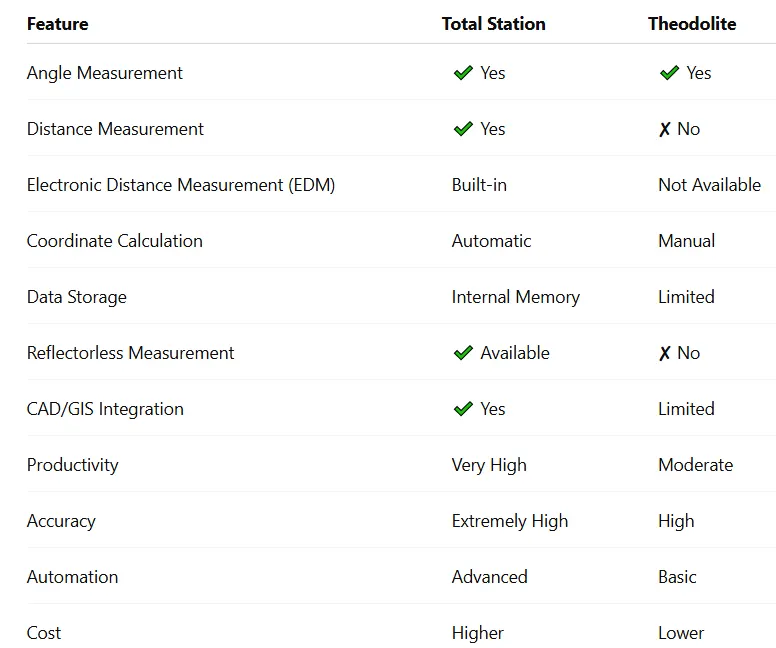
Accuracy Comparison
Accuracy is one of the main reasons professionals choose a Total Station over a traditional theodolite.
Total Station Accuracy
Modern Total Station models typically offer:
- Angle Accuracy:
- 1″
- 2″
- 3″
- 5″
Distance Accuracy:
±(2 mm + 2 ppm)
High-end robotic Total Stations provide even greater precision.
Theodolite Accuracy
Most digital theodolites provide:
- 2″
- 5″
- 10″
Since distance measurements are taken separately, overall accuracy depends on the operator and external equipment.
Advantages of a Total Station
A Total Station offers several advantages that make it the preferred surveying instrument for professionals.
Measures Angles and Distances Simultaneously
Unlike a theodolite, a Total Station measures angles and distances in one operation, saving significant field time.
Automatic Coordinate Calculation
The instrument instantly calculates:
- X, Y, Z Coordinates
- Northing
- Easting
- Elevation
Digital Data Storage
Thousands of survey points can be stored internally and exported directly to CAD software.
Faster Project Completion
Automatic calculations reduce manual work, allowing surveyors to complete projects much faster.
Reflectorless Surveying
Many Total Station models can measure inaccessible locations without using a prism.
Higher Productivity
One operator can perform tasks that previously required multiple people.
Advantages of a Theodolite
Although simpler, theodolites remain useful for certain applications.
Benefits include:
- Lower purchase cost
- Easy operation
- Reliable angle measurement
- Lightweight design
- Low maintenance
- Suitable for educational institutions
- Good for basic construction layout
Limitations of a Total Station
Despite its advanced features, a Total Station has a few limitations:
- Higher initial investment
- Requires operator training
- Battery dependent
- Advanced features may require software knowledge
However, these limitations are generally outweighed by increased productivity and accuracy.
Limitations of a Theodolite
A theodolite has several limitations when compared with a Total Station:
- Cannot independently measure distance
- Manual calculations required
- Slower workflow
- No automatic coordinate computation
- No digital mapping
- Limited data storage
- Greater risk of human error
Applications of Total Station
A Total Station is widely used in:
- Land Surveying
- Topographic Surveys
- Construction Layout
- Road Projects
- Railway Construction
- Tunnel Alignment
- Mining Surveys
- Bridge Construction
- Dam Construction
- Smart City Projects
- Industrial Plants
- Airport Construction
- Metro Rail Projects
- GIS Mapping
- Deformation Monitoring
Applications of Theodolite
Theodolites are commonly used for:
- Angle Measurement
- Building Alignment
- Column Positioning
- Road Alignment
- Educational Training
- Small Construction Projects
- Basic Land Surveys
Which Instrument is Better for Construction?
Modern construction projects demand speed, accuracy, and digital workflows. For these reasons, a Total Station is the preferred choice.
Benefits include:
- Faster layout work
- Higher accuracy
- Digital record keeping
- Automatic calculations
- Easy integration with engineering software
Most large-scale infrastructure projects today rely on Total Station technology.
Which Instrument is Better for Land Surveying?
Professional surveyors overwhelmingly choose a Total Station because it can:
- Measure thousands of points quickly
- Generate accurate coordinates
- Reduce manual errors
- Increase field efficiency
- Integrate directly with CAD and GIS software
Can a Total Station Replace a Theodolite?
Yes. A Total Station performs all the functions of a theodolite while adding several advanced capabilities, including:
- Distance measurement
- Coordinate calculation
- Digital data logging
- Reflectorless surveying
- CAD compatibility
- GIS integration
For this reason, many organizations have replaced traditional theodolites with Total Station systems.
Cost Comparison
Theodolites are usually less costly and are better suited to school or small projects.
A Total Station is more expensive, because it contains advanced electronics, laser measurement, on-board software and digital data storage. The initial cost is higher, but professionals will recoup their investment in long-term savings on labor, time and accuracy.
Total Station vs Theodolite: Which One Should You Choose?
Choose a Total Station if you need:
- High accuracy
- Distance measurement
- Automatic coordinate calculation
- Digital data collection
- Large-scale surveying
- Infrastructure projects
- CAD/GIS compatibility
Choose a Theodolite if you need:
- Basic angle measurement
- Educational training
- Small construction projects
- Budget-friendly surveying equipment
Related Surveying Resources
Continue learning about professional surveying equipment:
- Auto Level – Click Here
- Sokkia Auto Level – Click Here
- Robotic Total Station – Click Here
- Contact Us – Click Here