

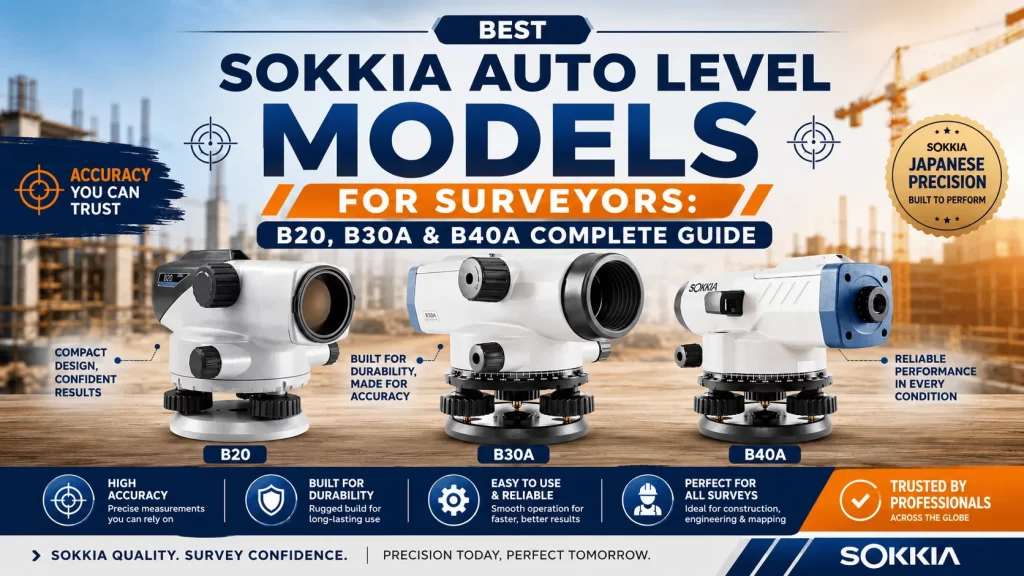
Selecting the proper survey instrument is necessary to guarantee accurate results in construction sites, infrastructure projects, road construction, land leveling and other civil engineering applications. Sokkia auto level instruments are known among established surveying equipment names for their practical field design, reliable automatic compensation and easy operation.
Sokkia’s B-Series automatic levels are available in varying magnification and accuracy. This enables surveyors to choose an instrument according to their project requirements. The range includes the B20, B30 and B40 models with magnifications of 32×, 28× and 24× respectively. Standard deviations for 1 km double-run leveling are also listed in the official Sokkia specifications as 0.7 mm for B20, 1.5 mm for B30 and 2.0 mm for B40 without micrometer.
In this guide, we will review the best Sokkia auto level models for surveyors, compare the B20, B30A and B40A, discuss their features and applications, and show how to choose the right model for your surveying needs.
What Is Sokkia Auto Level
A Sokkia auto level is an optical surveying instrument used mainly to determine elevation differences, transfer levels and check horizontal reference lines. This is different from a simple optical level where you have to adjust it more manually . An automatic level has a compensator that keeps the line of sight after the instrument has been roughly leveled .
Sokkia B-Series uses a pendulum compensator with a magnetic damping system. The working range is approximately ±15 minutes. This allows the instrument to keep a stable line of sight during normal field operations. The B-Series also features an IPX6 level of protection against water and dust.
The normal leveling procedure is to mount the instrument on a tripod, level it using the circular bubble, sight a leveling staff, and record readings at several points. Surveyors can then measure the difference in elevation between those points.
Automatic levels still serve many construction and civil engineering applications because of their straightforward workflow and reliable optical performance.
Why Use a Sokkia Auto Level for Surveying?
From project to project, the conditions for surveying can vary greatly. An instrument used on a large construction site may have to withstand dust, moisture, vibration and frequent transportation, yet still deliver consistent measurements.
The Sokkia B-Series has many features designed for field use. The series, Sokkia says, features rugged, compact bodies with IPX6 protection, quick setup, easy sighting and resistance to vibration and shock. The telescope is designed for a bright and sharp view and the horizontal motion controls help you quickly aim and align.
Another great advantage is that there are different levels of magnification and accuracy. Surveyors doing precision leveling can choose the higher precision B20, while those doing more routine construction and engineering leveling may want to consider B30A or B40A depending on their needs.
Typical applications are :
- Buildings and foundations demolition
- Roads and highways construction
- Site grading
- Excavating & draining works
- Transfer of elevation
- Validate and establish benchmarks
- building layout
- General Survey of Civil Engineering
Best Sokkia Auto Level Models for Surveyors
The most commonly considered models in the B-Series are the B20, B30A and B40A. They share the basic concept of automatic optical leveling but differ in telescope magnification and specified leveling accuracy.
Model | Magnification | Standard deviation for 1 km double-run leveling* | Typical use |
Sokkia B20 | 32× | 0.7 mm | Precision leveling |
Sokkia B30A | 28× | 1.5 mm | General surveying and construction |
Sokkia B40A | 24× | 2.0 mm | Routine construction and engineering leveling |
*Values shown are for leveling without a micrometer according to Sokkia’s B-Series specifications.
Sokkia Auto Level B20 –
The Sokkia B20 automatic level is the more accurate option of the B-Series. It has the highest telescope magnification of 32× of the B20/B30/B40 models, and Sokkia claims a standard deviation of 0.7 mm for 1 km double-run leveling without a micrometer. With the optional micrometer the stated figure can be reached at 0.5 mm.
The B20 also has a 42 mm objective aperture, resolution of 3 arc seconds and two-speed focusing knob. The minimum focusing distance is 0.2 m from the end of the telescope, or about 0.3 m from the center of the instrument, which may be useful when working in relatively confined locations.
So the B20 would be a good choice for surveyors who place more emphasis on the leveling accuracy and the magnification of the telescope.
Typical applications are precision elevation transfer, control leveling, engineering surveys and construction projects that require more stringent leveling tolerances.
To improve leveling accuracy, the B20 can be used with a parallel plate micrometer option. From the Sokkia documentation, the use of the micrometer can increase the accuracy of 1 km double-run leveling from 0.7 mm to 0.5 mm.
Sokkia B30A Auto Level-
The Sokkia B30A is somewhere between the B20 and B40A in terms of telescope magnification and stated leveling accuracy. It has 28× magnification, 1.5 mm standard deviation in double-run leveling over 1 km without a micrometer. 36 mm objective aperture provides a practical balance for everyday construction and surveying work.
The B30A is a good compromise level for the surveyor who may not require the higher accuracy spec of the B20 but still requires a reliable auto level for all the day to day work in the field.
It is helpful for building construction, road works, site leveling, drainage work, elevation checks and other general civil engineering works.
The B-Series also includes a graduated horizontal circle that permits the measurement of horizontal angles and is useful for simple layout and alignment tasks. The horizontal circle graduations are 1°/1 gon as specified by Sokkia.
Sokkia B40A Auto Level-
The Sokkia B40A Auto Level is an automatic level that is ideal for surveyors and construction professionals who require a practical automatic level for routine leveling and engineering applications.
The B40A is the lowest magnification model of the B20/B30/B40 group with 24× magnification with a 32 mm objective aperture. It has a specified standard deviation of 2.0 mm for 1 km double-run leveling without a micrometer.
The auto level sokkia B40A can be useful for everyday construction activities like checking foundation levels, transferring elevations, checking grades and carrying out general site leveling.
If a company has several construction sites, the ease of setup and durability in the field can be especially important. The B-Series includes fast collimation, horizontal motion controls and IPX6 protection for regular outdoor operation.
Do not think that the Sokkia auto level B40A is the model with the highest precision of the range, just because it is widely used for construction. The B20 has the lower stated leveling deviation and thus a more stringent specification for precision leveling. The selection depends on the tolerance that is needed for the project.
Sokkia B20 vs B30A vs B40A – Which One is Better?
There is not a single best Sokkia auto level for every surveyor. The right choice depends on the required accuracy, the working distance, the project type and the field conditions.
When precision is the priority, choose Sokkia B20
For projects where more accuracy in leveling and a higher telescope magnification are needed, the B20 is the obvious choice. The spec of 0.7mm standard deviation without a micrometer, combined with 32× magnification, gives it the highest accuracy spec of these three models.
Choose Sokkia B30A for the right mix of field requirements
The B30A should be considered where surveyors require a balance of magnification, accuracy and general-purpose use. Its 28× magnification and stated deviation of 1.5 mm make it suitable for many routine construction and surveying operations.
Leveling select Sokkia B40A general construction
The B40A is well suited for routine site leveling, elevation checks and general construction work where the project tolerance requirements are compatible with its specifications. It is the more general-purpose of the three models, with 24× power and a stated deviation of 2.0 mm.
Key Considerations to consider when buying a Sokkia Auto Level
You can not just select an automatic level based on the model name. Surveyors should evaluate several factors before making a purchase.
1.Accuracy required
Start with the project’s leveling tolerance. Routine construction leveling may require a different instrument than precision engineering and control work.
2.Magnification of the telescope
When the leveling staff has to be seen from longer distances, high magnification can be useful. The B20 offers 32x, the B30A 28x and the B40A 24x magnification.
3.Work environment
Outdoor survey instruments are exposed to dust, moisture and temperature changes. According to Sokkia, the B-Series features IPX6 protection and an operating temperature range of -20°C to +50°C.
4.Operating simplicity
Frequent site work calls for fast setup, easy sighting and simple controls. Some features that can improve practical use in the field are fast collimation and double-sided controls for horizontal motion.
5.Service and calibration support
Instrument accuracy also relies on proper maintenance, periodic checking and calibration. Buyers should therefore consider not only the instrument, but also the availability of original accessories, technical support, calibration and after sales service.
Sokkia Auto Level vs Sokkia Total Station
Surveyors often compare an automatic level to a Sokkia total station. However, they are designed for different main tasks.
Sokkia Auto Levels are mainly used for establishing and transferring elevations, checking levels and establishing horizontal reference lines. A total station, on the other hand, combines angle measurement with electronic distance measurement and is intended for more comprehensive surveying workflows.
The electronic total station can be used for the angular, linear, coordinate, position and detailed site survey. Generally, an auto level is the easier choice if the main task is leveling and elevation work.
So, it’s up to the project to choose between the two. For routine elevation work, an auto level can be used by a construction team; the total station can be used for coordinate-based layout and total surveying.
Also, people looking for a sokkia total station price should compare the specifications of the model, accessories, software capabilities and required field applications rather than just the price. Actual prices vary by model and configuration. For the most current model-specific pricing, contact an authorized distributor.
Getting Better Results from a Sokkia Auto Level
If a good instrument is to produce reliable results, it has to be used properly in the field.
Always set the tripod on a firm surface and level the instrument correctly before taking readings. If possible, avoid setting up on loose soil, and check the circular bubble before you start measuring.
The staff should be held vertically. Surveyors must be careful to avoid parallax when reading the telescope. A good balance between backsight and foresight distances can minimize the effect of some field errors in more demanding leveling work.
Also, instruments should be inspected regularly. Check the condition of the compensator, the optics, the circular level and the horizontal movement mechanism and perform calibration and service as needed.
Why Purchase Sokkia Auto Level from an Authorized Distributor?
In addition to the initial purchase of the instrument, there are also benefits to buying survey equipment from an authorized or established distributor.
Technical advice on model selection, genuine accessories, calibration support, servicing and after-sales assistance may be needed by professional users. These factors could be crucial for those companies that rely on surveying instruments for their daily on-site operations.
Before purchasing any Sokkia auto level, surveyors should verify the exact model, specifications, accessories included, warranty terms, service support, and calibration options.
For multi-location organizations, a large service network can reduce equipment downtime and make maintenance easier.
Sokkia Auto Level FAQ
The best model depends on the application and the accuracy needed. The B20 has the highest stated magnification and the lowest standard deviation for 1 km double-run leveling among B20, B30A and B40A. The B30A and B40A are more suitable for general surveying and construction needs.
The Sokkia B20 automatic level is designed for automatic optical leveling and can be particularly useful where higher accuracy leveling and higher telescope magnification are required.
The Sokkia B40A auto level is suited for general construction leveling, elevation transfer, site grading, foundation work, road construction and general engineering applications depending on the accuracy level needed for the project.
The big differences are the telescope magnification and the stated level accuracy. The B20 provides 32× magnification and 0.7 mm standard deviation, and the B40A provides 24× magnification and 2.0 mm standard deviation for 1 km double-run leveling without a micrometer.
The automatic levels are used mostly in the determination of elevation changes and for the establishment of level reference lines. It is extensively used in building construction, road work, drainage, site grading and civil engineering applications.
Neither instrument is universally superior. They are ideal for different surveying needs. The auto level is very useful for leveling and elevation work. A total station would be more appropriate when angle, distance and coordinate measurements are required.
Sokkia B-Series horizontal circle has 1°/1 gon graduations for horizontal angle measurement. But an automatic level should not be thought of as a substitute for a total station when full electronic angle and distance measurement is needed.
Conclusion
If you are a surveyor, civil engineer or construction professional who does leveling and elevation work regularly, a dependable auto level can be a valuable tool to have. The B-Series offers choices for varying required accuracy and telescope magnification.
The Sokkia B20 is the most accurate of the three discussed. It has 32× magnification and 0.7 mm standard deviation for 1 km double-run leveling without a micrometer. The Sokkia B30A is a balanced model for general surveying and construction. The Sokkia B40A auto level is more for routine construction and engineering leveling.
Surveyors should consider the accuracy requirements, telescope magnification, site conditions, instrument durability, accessories, and calibration and after-sales support before purchasing. Choosing the model to match the actual application will ensure the equipment delivers reliable performance throughout the project.
For Sokkia auto level model selection, availability, specifications, genuine accessories, calibration and technical support, contact an authorized surveying equipment distributor for the best solution for your project.