

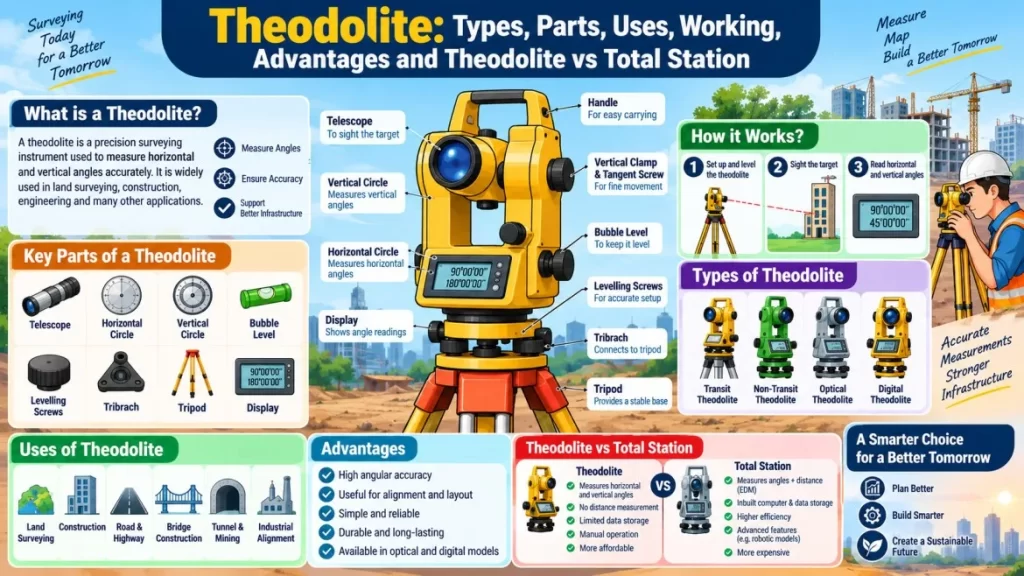
A theodolite is a surveying instrument that measures angles, especially horizontal and vertical angles, with great precision. It has been an important tool in land surveying, construction, civil engineering, infrastructure development and other precision measurement applications.
Modern surveying has brought in sophisticated equipment such as total stations, GNSS receivers and robotic total stations, but the theodolite still has its uses for projects that require precise angular measurement, alignment, levelling-related work and layout.
In many instances the reading difficulties associated with the conventional optical instruments are eliminated in modern electronic theodolites. The use of digital models makes it possible to show the angular readings electronically instead of reading graduated circles manually, which increases productivity in the field and reduces reading errors.
This comprehensive guide covers what a theodolite is, how it functions, its parts, types, applications, advantages, disadvantages, setup, and the difference between a theodolite and a total station.
What Is a Theodolite?
Theodolite is an instrument used in surveying for measuring angles (both horizontal and vertical) with great accuracy.
It is primarily a telescope mounted to rotate around horizontal and vertical axes. The surveyor can determine directions, angles and relationships between points by sighting a target from different directions and recording the corresponding angular readings.
Theodolites are usually used for:
- Land and building surveyors
- Alignment building
- Road and highway construction
- Infrastructure and bridge projects
- Walking in
- Setting right angles
- Measurement of angle (horizontal and vertical)
- Establishment of lines, and directions
- Structural alignment
- Monitoring and deformation applications
Historically , instruments have developed from earlier surveying and astronomical instruments . Gemma Frisius made an important contribution to the development of triangulation methods in the sixteenth century . Later instrument makers developed ever more precise angular measurement equipment . The evolution eventually gave way to the modern transit and electronic theodolite.
How Does a Theodolite Work?
The fundamental principle of working of a theodolite is to measure angles with great precision.
The telescope is pointed at a survey point or target. The instrument records its horizontal and vertical azimuths. The surveyor then swings the telescope to another target and measures the difference between the two directions.
For example, a surveyor may want to measure the angle between points A and B from station P:
- The theodolite is correctly centered over station P.
- The instrument has been leveled.
- The telescope is aimed at point A.
- The horizontal read is noted.
- The telescope is turned to point B.
- The second reading is noted.
- The horizontal angle is found by taking the difference of the two readings.
The same principle applies in the measurement of vertical angles.
A digital theodolite gives the angular value directly on the electronic display. …relative to conventional instruments with graduated circles and optical reading systems. Modern electronic models can achieve angular accuracies in the arc-second range (depending upon the instrument specification).
Parts of a Theodolite and Their Functions
Anyone studying surveying or choosing a surveying instrument ought to know the parts of a theodolite.
1Telescope
The telescope is to sight distant points or targets. It houses the optical system and reticle which allows the surveyor to accurately align the line of sight.
2.Objective Lens
The light from the target is collected and an image is formed in the objective lens that is viewed through the telescope.
3.Eye piece
The target image and reticle are clearly visible to the operator through the eyepiece.
4.Horizontal Circle.
Horizontal circle – angular measurement in the horizontal plane. 2. In electronic theodolites the angular position is provided by an encoder and electronic system.
5.Vertical Circle
The vertical circle is for measuring the vertical angles. It serves to determine the inclination of the telescope relative to the horizontal plane.
6.Tangent Screw and Horizontal Clamp.
These controls help in the locking and fine tuning of the horizontal rotation of the instrument.
7.Vertical Clamp and Tangent Screw
It serves to lock the telescope and to fine-tune it in the vertical direction.
8.Screws for Leveling
The instrument is properly leveled after mounting on the tripod by means of the leveling or foot screws.
9.Spirit Level
The surveyor checks that the instrument is level using the bubble level.
10.Optical Plummit
An optical plummet helps to center the instrument over the survey station.
11.Tribrach
The tribrach provides the required mechanism for mounting, centering and leveling the instrument to the tripod.
12.Tres patas
The tripod provides a firm and stable base for the theodolite during measurement.
The practical use of theodolites is highly dependent on correct centering, leveling and a stable support for the instrument, as an incorrect setup can lead to errors in the measurements, regardless of the instrument’s nominal accuracy.
Types of Theodolite
Theodolites have different types based on their construction, measurement system and operation.
1.Theodolite, Transit.
A transit theodolite allows the telescope to rotate in a vertical plane and to be transited through about 180 degrees. Surveyors widely adopted transit instruments because they were flexible for sighting and alignment operations.
Most of the modern theodolites are based on the concept of transit.
2.Theodolite Non-Transit
In a non-transit type instrument the telescope has less vertical movement. Compared with modern surveying equipment, these instruments are of historical interest only.
3.Optical Theodolite
The optical theodolite measures the horizontal and vertical angles using optical systems and graduated circles. With such instruments very accurate angular readings can be obtained but skilled operators are required.
4.Digital Theodolite
A digital theodolite uses electronic angle sensors or encoders and digitally shows the measured values.
Benefits may include:
- easier to read
- Speedier observation
- Fewer reading errors
- Electronic angle indicator
- Higher field productivity
Digital theodolites are still available for survey and construction applications. Current commercial models include digital displays, electronic encoders, optical plummets, and arc-second angular accuracy.
5.Theodolites with Repetition and Direction
Besides the theodolites, the traditional classification includes the theodolites intended for repeated angle observations and the directional theodolites for finding directions from measured circle readings.
How to Set Up a Theodolite Correctly
One of the most important factors for accurate surveying is proper setup.
Step 1: Get the tripod set up
Position the tripod over the survey station. Firmly spread tripod legs and adjust height to suit comfortable operation.
Step 2. Set up the Theodolite.
Firmly fix the theodolite to the tripod or tribrach.
Step 3: Centering the Instrument
Use the optical plummet or plumb system to bring the vertical axis of the instrument directly over the station point.
Step 4: Level the Instrument
Turn the foot screws and reposition the tripod until the bubble is in the middle.
Step 5: Center Check Again
The instrument position might move a little during leveling, so recheck the optical plummet.
Step 6: Point the Telescope
Focus the eyepiece and the objective until the reticle and target are sharp.
Step 7: Verify the Target
Use the telescope to sight exactly on the survey point required .
Step 8: Read the Angular
Record the angle horizontally and/or vertically.
Surveyors can make observations with the telescope in different positions and apply the appropriate observation and adjustment procedures when doing high-precision work. Field practice and instrument calibration is important for reliable results.
Applications of Theodolite
The theodolite survey instrument is used in a number of industries.
1.Land Surveying
Theodolites . Measure directions and angles between points of survey . These observations may be used for traverses, for topographic work and for establishing control.
2.Construction Surveys
A theodolite can help establish straight lines, right angles, alignment and other geometric references on construction sites.
3.Building orientation
Theodolites are also used by surveyors to check structural elements are located in the correct design coordinates and alignment.
4.Construction of Roads and Highways
The instrument can be used for horizontal and vertical alignment setup for road projects depending on the surveying workflow.
5.Building a Bridge
Precise angular observations are essential in the alignment and layout of bridge parts.
6.Tunnel construction
Angular measurements can be used by surveying teams in the establishment and checking of tunnel alignment and control networks.
7.Industry Alignment
Theodolites may also be used for the precise alignment of equipment, structural members and reference lines.
8.Surveying in Mining
Theodolites have been used for underground and surface surveying though modern mining projects may use total stations, GNSS and scanning technologies .
9.Control and Topographic Surveys
Angular observations are useful in control networks and other surveying applications.
Advantages of a Theodolite
Depending on the application, a quality digital theodolite can provide many advantages.
High Angular Accuracy
Theodolites are primarily used for precise measurement of horizontal and vertical angles.
Good for alignment
It is very good for straight line alignment, angle checking and layout.
Digital Operation
Electronic models can improve field productivity and help interpret readings.
Multiple Uses
Theodolites are used in land survey, civil engineering, construction and industrial alignment.
Pretty Straightforward Measurement Idea
The basic function of a theodolite is simple , to measure angles and directions accurately in comparison to more sophisticated integrated systems .
Limitations of Theodolite
Theodolite technology is accurate but it does have its limits.
Range Finding
A total station has integrated electronic distance measurement that a conventional theodolite does not have.
Additional Manual Work
In general, coordinate-based surveying requires additional procedures and equipment on the part of the operator.
Data Collection
Traditional theodolites typically provide fewer options for data management onboard than modern total stations.
Requires skilled operation.
Accurate centering, leveling, sighting and observation procedures are to be performed by trained personnel.
Fewer Automations
A theodolite generally lacks the robotic target tracking and remote operation features of robotic total station systems.
Theodolite vs Total Station: What Is the Difference?
One of the most common questions surveying professionals ask is: theodolite vs total station – which one should you choose?
Theodolite and total station are related surveying technologies, but they are not the same instrument.
Theodolites measure horizontal and vertical angles. Total stations are the combination of angular measurement with electronic distance measurement (EDM), on-board computing and digital data capabilities.
Feature | Theodolite | Total Station |
Horizontal angle | Yes | Yes |
Vertical angle | Yes | Yes |
Electronic distance measurement | Usually no | Yes |
Coordinate calculation | Limited/manual workflow | Integrated |
Data storage | Limited depending on model | Common |
Digital display | Digital models | Yes |
Survey data collection | More manual | More integrated |
Automation | Limited | More advanced |
Remote/robotic operation | Generally no | Available on robotic models |
Typical use | Angular measurement & alignment | Complete digital surveying |
A total station can therefore reduce the amount of manual calculation and equipment required for many modern surveying workflows.
Theodolite vs Auto Level
The major purpose of a theodolite and an auto level is different.
Theodolites are used mainly to measure horizontal and vertical angles and auto levels are used mainly to determine differences in elevation.
An auto level establishes a horizontal line of sight using a telescope and automatic compensator. It is frequently used for:
- Shift level
- Performance testing
- Checking altitude
- Foundation work:
- Roadworks Earthworks Building works
Therefore, the choice between a theodolite and an auto level should be made depending on the project which requires either angular measurement or elevation/level measurement.
Sokkia Auto Level vs Theodolite
Surveyors who are looking for reliable leveling equipment, often search for the phrase Sokkia auto level.
As a general rule, if your primary need is accurate elevation and leveling work, you would use a Sokkia auto level. In the main task, however, where horizontal and vertical angles are to be measured, the theodolite is the instrument of choice.
Contractors and survey teams working on projects involving angle and elevation may use multiple instruments or a more integrated solution such as a total station.
This is an important distinction as an auto level should not be used in place of a theodolite in angular surveying.
Theodolite vs Robotic Total Station
The robotic total station is another step forward in the automation of surveying.
A robotic total station integrates angular measurement and EDM with motorized instrument movement, target tracking and remote operation capabilities depending on the model and system.
A robotic total station can provide compared to a traditional theodolite:
- Automatic target tracking
- Instruments remote control
- Electronic distance measurement
- Digitally collect coordinates
- Less manual instrument rotation required
- More field productivity for many workflows
Robotic total station technology can provide considerable workflow advantages for large construction projects, infrastructure sites and surveying operations where one person operation or automation is of value.
However a theodolite maybe a suitable instrument for projects where the main requirement is for accurate angle measurement and a simpler instrument is sufficient.
Theodolite Accessories
The right accessories can increase field efficiency and protect the instrument.
Tripod
You need a sturdy tripod for accurate observations.
Tribrach
A tribrach allows for secure mounting, leveling and centering.
Targets and Prism
Targets allow the surveyor to find a point to sight on. Prism systems are typically used in EDM and total station workflows.
Case
A protective case protects against dust, moisture and physical damage in transit.
Charger and Batteries
A reliable power source is required for digital theodolites. A spare battery charged up can help to avoid interruptions.
Data collection
Data collectors are especially important for total stations and more sophisticated digital surveying workflows, although some digital theodolite workflows may use external recording systems.
How to Choose the Right Theodolite
When buying a theodolite, don’t just consider the price. Think about the actual needs of your survey work.
1.Angular Precision
This is one of the most important specs. Choose an accuracy class that is right for your project
2.Quality of Telescope
Check magnification, optical quality, field of view, and minimum focusing distance.
3.Digital screen
The observations can be made more quickly and easily interpreted in the field with a clear digital display.
4.Compensator
Check the leveling and compensation system of the instrument.
5.Optical Dive
If you have a good optical or laser plummet it can make centering your station easier .
6.Longevity
Survey equipment is often exposed to dust, vibration, sun and changing weather conditions. A tough instrument may be useful for field work.
7.Service and Calibration
Calibration and service availability are important factors when you’re investing in professional surveying equipment, and after-sales support is part of the package.
For professional users, purchasing from an experienced surveying equipment supplier can be as important as the choice of instrument.
Theodolite Price in India
The theodolite price in India depends on the type of instrument, angular accuracy, brand, telescope specifications, electronic features, accessories and service support.
Entry level or basic instruments can be much cheaper than professional high precision instruments. However, the advanced electronics of digital theodolites usually mean a higher price than simple optical instruments.
Surveyors should compare, rather than just picking the cheapest equipment:
Precision + Functionality + Reliability + Guaranty + Adjustment + After Sales
An instrument may be cheap but is it the right one for professional surveying? If you cannot get calibration and after sales service easily then you may be better off paying a little bit more for your instrument.
Theodolite Maintenance and Calibration
Regular care is needed to keep your measurements accurate.
Keep the telescope and all optical elements clean and protected. Do not touch optical surfaces unless necessary. Store the instrument in its protective case when not in use.
The instrument should also be checked and calibrated in accordance with the manufacturer’s recommendations and the accuracy requirements of the surveying work.
General field precautions are:
- Before starting important work, check the instrument.
- Carefully check for centering and leveling.
- No wobbly triple mounts.
- Keep the instrument from unnecessary shocks.
- Protect sensitive parts from dust and moisture.
- Professional calibration as required.
Calibration and periodic verification should not be neglected for high accuracy surveying.
Theodolite FAQs (Frequently Asked Questions)
Theodolites are mainly used to measure horizontal and vertical angles . It is popularly used in surveying, construction, engineering, alignment and layout work.
Yes. While total stations and GNSS technologies have become commonplace, theodolites are still useful for angular measurement, alignment and specific surveying applications.
The main use of a theodolite is to measure angles. Total station combination of electronic distance measurement, angular measurement, computing and digital survey-data functions.
There is no universal best. Where the main requirement is the accurate measurement of angles, a theodolite can be suitable. For a project where the measurement of combined angle, distance and the coordinate is needed, a total station is usually preferred.
A digital theodolite is an electronic surveying instrument that measures horizontal and vertical angles and displays the results digitally.
Final Thoughts
The theodolite still is one of the most important instruments in the development and history of modern surveying. Because the instrument can accurately measure horizontal and vertical angles, it has been very useful for land surveying, construction, engineering, alignment and infrastructure projects.
Modern digital theodolites have electronic measurements of angles and digital displays making the instrument more user friendly for field observations. In parallel, the use of total stations, auto levels, GNSS receivers and robotic total stations is becoming more and more integrated and automated workflows.
Ultimately, the best surveying instrument will be dependent on the project. A theodolite may be a good solution if the main requirement is accurate angular measurement. If you are measuring distance, calculating coordinates and collecting digital data a total station may be a better option. An auto level can be the right tool for the job for elevation work.
Professional surveying applications require choosing an instrument with appropriate accuracy, reliable calibration and dependable technical support to achieve consistent field results.