

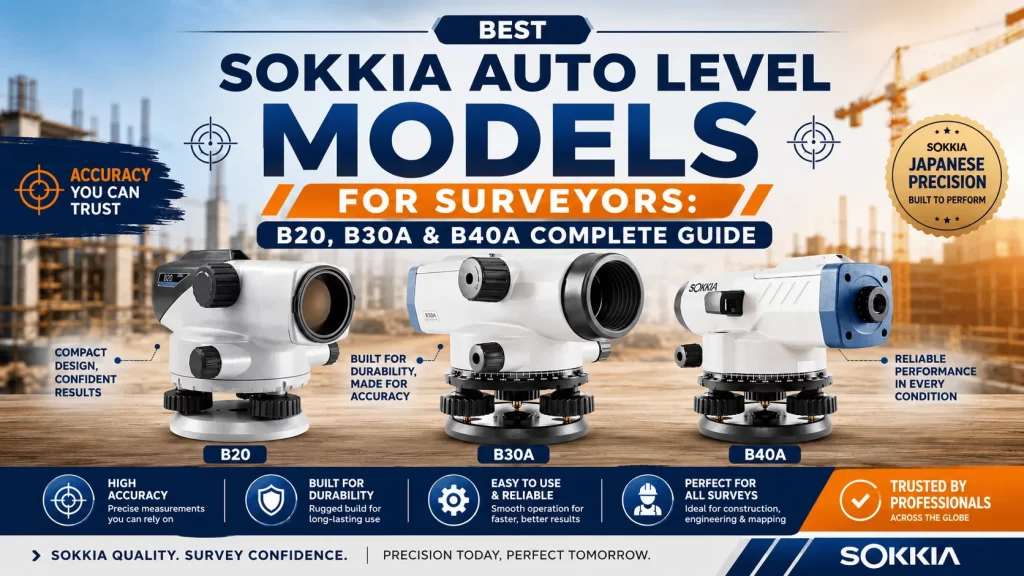
One of the most important requirements in surveying, construction, infrastructure development, road projects, drainage work, and building layout is accurate elevation measurement. A small mistake in height can influence foundations, floor levels, drainage slopes, road grades, and structural alignment.
The two common instruments used for precise leveling are the auto level and the digital level.
Both instruments are designed for determining elevation differences, but they use different measurement technologies and different levels of automation, productivity and data handling.
An auto level, also called an automatic optical level, employs a telescope and an internal compensator to establish a horizontal line of sight. The surveyor manually sights a leveling staff. The staff is read through the telescope.
A digital level pairs a precision telescope with electronic image processing. The instrument does not depend on the operator reading the staff. It electronically identifies a coded staff and computes the measurement.
Modern digital levels can reduce reading-related errors, provide an electronic record of observations and help to speed up the processing of precision leveling work. Topcon and Leica are among the manufacturers offering optical and digital leveling solutions for various surveying needs.
What Is an Auto Level?
An auto level is an optical instrument used in surveying to measure the height differences between points.
The instrument is mounted on a tripod and approximately leveled with the aid of its foot screws and a circular bubble. Then the internal automatic compensator compensates for small residual tilt of the telescope and establishes a near horizontal line of sight.
The operator looks through the telescope and reads a graduated leveling staff placed at the point of measurement.
A typical differential leveling calculation would use:
HI = RL of Benchmark + BS
Then:
RL of Point = HI – Back Sight
Where:
RL = Reduced Level
HI = Height of Instrument BS = Back Sight FS = Fore Sight
For instance, if a benchmark has an RL of 100.000 m and the backsight reading is 1.250 m:
HI = 100,000 + 1,250 = 101,250 m
If the foresight reading on another point is 2,100 m:
RL = 101.250 – 2.100 = 99.150 m.
This simple technique makes the auto level extremely useful in daily construction and engineering works.
Compensators used in modern automatic optical levels are designed to stabilize the line of sight. One example of this is Topcon’s AT-B series which uses a magnetic damping system and a pendulum type compensating mechanism. Models are available in 24x, 28x and 32x magnification.
Main Features of an Auto Level
An auto level typically provides:
- Automatic compensation for small instrument tilts
- Optical telescope with magnification
- Manual staff reading
- Horizontal angle reference through a horizontal circle on many models
- Fast field setup
- Low power dependence because optical measurement does not require electronic measurement
- Rugged operation for construction environments
For example, Topcon’s AT-B series is rated IPX6 and is designed for operation from approximately -20°C to 50°C, demonstrating how optical levels can be designed for demanding jobsites.
What Is a Digital Level?
A digital level is a more advanced leveling instrument that electronically calculates staff readings.
Instead of the operator manually estimating the staff graduation through the telescope, a digital level observes a special coded leveling staff with the help of an optical/electronic sensor system. The instrument reads the pattern of lines and calculates the height and, depending on the model, the line spacing.
This changes the field workflow considerably.
The surveyor must still set up the tripod, sight at the staff, focus correctly depending on the instrument and make sure the staff is in the correct position. But the critical staff-reading step can be automated.
Modern digital levels might also include:
- Electronic height measuring
- Electronic distance measurement (
- Internal Data Storage Capacity
- Leveling programs
- Mean of measurements
- Functions of a stakeout
- Data transfer interface (USB, Bluetooth or other)
- Autofocus top-of-the-line models
For example, Topcon’s DL-500 digital level series includes electronic measurement features, memory for up to 2,000 measurements and inverse staff reading for applications such as ceiling measurements.
The state of the art in advanced digital leveling are the Leica LS10 and LS15 digital levels. The systems come equipped with electronic height measurement, internal data storage for up to 30,000 measurements, Bluetooth connectivity and measurement times of approximately 2.5 seconds, depending on configuration
Auto Level vs Digital Level: Key Differences
The easiest way to understand the difference is to compare their technology and field workflow.
Feature | Auto Level | Digital Level |
Measurement method | Optical/manual reading | Electronic image recognition |
Staff reading | Manual | Automatically interpreted |
Compensator | Yes | Yes |
Reading errors | More operator-dependent | Lower operator reading dependency |
Data recording | Usually manual | Electronic/internal memory on many models |
Speed | Fast | Generally faster for repetitive precision work |
Field book requirement | Usually required | Reduced for digital recording workflows |
Data processing | Manual calculations often required | Automated calculations available on many models |
Power requirement | Minimal | Battery required |
Initial investment | Generally lower | Generally higher |
Precision applications | Good to excellent depending on model | Excellent, especially for precision workflows |
Training | Relatively simple | Requires digital workflow familiarity |
Ideal use | General construction and engineering | Precision, repetitive and data-intensive levelling |
The most important point is that an auto level is not simply an older and less accurate version of a digital level. High-quality automatic optical levels can provide excellent precision. The major difference is the method of observation, recording, and operator involvement.
Auto Level vs Digital Level: Working Principle
How does a Auto Level Works
The workflow is:
Set up tripod Approximate leveling Automatic compensation Staff to sight Read graduation Record measurement
The circular bubble is used to bring the instrument nearly to level. The compensator then corrects small residuals tilts.
The surveyor reads the staff visually, generally through the central horizontal crosshair. The measurements from the upper and lower stadia can also be used to calculate approximate distance.
Operator technique is relevant. The reading is a visual interpretation. The result may be affected by poor focusing, parallax, improper holding of the staff, atmospheric effects, or misreading the graduation.
How does a digital level work
The workflow is then:
Tripod Setup → Leveling → Aim Staff → Electronic Recognition → Calculation of Measurement → Digital Recording
The telescope views a barcode or coded leveling staff. The image of the staff is captured by an electronic sensor and the measurement is done by the instrument’s processing system.
This reduces the manual interpretation required from the operator.
But electronic automation does not remove all survey errors. The instrument still requires proper set up, stable tripods, proper staff handling, calibration, atmospheric conditions and proper field procedures.
Accuracy: Is a Digital Level More Accurate Than an Auto Level?
This is one of the most common questions when comparing an auto level vs digital level.
There is no universal answer that applies to every instrument.
Accuracy depends on:
- Instrument specification
- Telescope quality
- Compensator performance
- Staff quality
- Staff material
- Operator technique
- Sight length
- Atmospheric conditions
- Instrument calibration
- Tripod stability
- Levelling procedure
- Required observation method
High-precision digital levels can achieve extremely small standard deviations when paired with appropriate precision staffs.
For example, Leica’s LS10 and LS15 digital levels are specified for height measurement accuracies as low as 0.2–0.3 mm under particular Invar-staff configurations, depending on the model.
At the same time, professional automatic optical levels can provide very strong precision for construction and general engineering applications. Sokkia’s B-series, for example, includes models with stated 1 km double-run levelling accuracy ranging from 0.7 mm to 2.0 mm depending on model.
Therefore, the correct question is not simply:
“Is digital level more accurate?”
Instead, ask:
“What level of measurement uncertainty does my project require?”
For ordinary construction levelling, an accurate auto level may be more than sufficient. For high-precision deformation monitoring, precise benchmarks, control networks, or demanding geodetic work, a suitable digital level may provide a more efficient and repeatable workflow.
Major Advantages of an Auto Level
1.Inexpensive Surveying Services
One of the greatest benefits of an auto level is that they are fairly simple in design.
An auto level can be a reliable method of elevation measurement for organizations that do regular building, road, drainage or general construction work without the large investment in technology that advanced digital instruments require.
2.Easy Operation
The operating concept is simple to understand:
Set up the instrument, level it, sight the rod and read the measure.
This makes the auto level a very useful tool for construction teams looking for a practical field instrument.
3.Hard Working Jobsite Performance:
Good automatic levels can be designed to withstand dust, moisture, vibration, and temperature changes.
Topcon and Sokkia optical level products, for example, are designed for construction environments with an emphasis on vibration resistance, compensator stability and water protection.
4.No reliance on electronic storage
Readings are taken directly through the telescope, so an auto level can still be useful even without a digital workflow.
This simplicity is an asset for basic construction applications.
Major Advantages of a Digital Level
1.Fewer human reading errors
The big advantage of a digital level is that it reads the staff automatically.
The operator does not need to visually interpret each staff graduation. This minimizes the opportunities for errors caused by manual reading and transcription
2.Quicker Repetitive Leveling
If there are many observations on a project, storing each reading in an electronic file can speed up the whole process considerably.
Rather than repeatedly:
Read -> Write -> Compute -> Check
The process may be:
Measure → Record → Review
3.Handling of Digital Data
The majority of digital levels include internal memory and communication options.
For example, the Leica LS10 and LS15 models have internal storage capacity for up to 30,000 measurements. Sophisticated connectivity options enable the digital transfer of data.
This can be very useful if you need to archive, transfer, review or process the measurement records at a later time.
4.Advanced Functions for Leveling
For certain instruments, digital levels can perform functions such as:
Auto measurement
Average measurements
Calculation of staff height and distance
Leveling programs
Surveillance
Network Configuration Workflows
Electronic field recordings
These features can be a huge benefit on large precision leveling projects.
Where Is an Auto Level Used?
An auto level is widely used for:
Building Construction
Surveyors use it for checking:
- Foundation levels
- Plinth levels
- Floor levels
- Column elevations
- Slab levels
- Drainage slopes
Road Construction
It can help establish and verify:
- Road grades
- Formation levels
- Pavement elevations
- Kerb levels
- Drainage elevations
- Cross-section points
Civil Engineering
Common uses include:
- Earthwork
- Excavation
- Canal construction
- Culverts
- Foundations
- Retaining walls
- Pipe installation
General Site Surveying
An auto level is useful whenever the primary requirement is accurately transferring or comparing elevations.
Where Is a Digital Level Used?
Digital level is especially attractive when projects call for accurate, repeatable, and data-rich observations.
Typical uses include:
Precision Leveling
Digital levels are suitable for precise height determination and benchmark networks .
Infrastructure Initiatives
For large infrastructure projects large elevation records at many control points may be required. Electronic data collection can streamline these workflows.
Monitoring of Deformation
Structures such as bridges, dams and other critical infrastructure require repeated high precision elevation observations. In such situations, it may be useful to standardize and electronically record readings.
Controls for Survey
Digital leveling has workflow advantages where repeatability and detailed observation records are important .
ISO 17123-2 gives field procedures for testing the accuracy of leveling instruments such as compensator levels and digital levels for building and survey leveling measurements.
Which Is Better for Construction: Auto Level or Digital Level?
For most standard construction projects, an auto level is often the practical choice.
A contractor working on residential buildings, commercial structures, roads, drainage, or general civil works may not need the additional digital data functions of a high-end digital level.
The decision changes when:
- The number of observations is very high
- Manual transcription is creating problems
- Precision requirements are demanding
- Data needs to be electronically stored
- Quality control requires repeatable digital records
- Surveying forms a significant part of the project’s workflow
In these situations, a digital level can provide greater productivity and control.
Auto Level vs Digital Level: Which One Should You Buy?
Before purchasing a surveying level, evaluate the following factors.
1. Required Accuracy
Do not select an instrument only because its advertised specification is attractive.
Determine the accuracy requirement of your project first.
2. Project Type
For general construction, an auto level is often sufficient.
For precision surveying and data-heavy workflows, consider a digital level.
3. Frequency of Use
If the instrument is used occasionally, the lower complexity of an auto level may be advantageous.
For daily high-volume surveying, the productivity benefits of a digital level may justify the additional investment.
4. Staff Compatibility
A digital level usually requires the correct coded or barcode staff. Staff quality can have a direct influence on the achievable measurement performance.
Precision applications may use specialized Invar staffs because of their low thermal expansion. Leica, for example, offers Invar levelling staffs specifically for high-precision applications.
5. Environmental Conditions
Consider:
- Dust
- Rain
- Heat
- Vibration
- Long sight distances
- Sunlight
- Uneven terrain
Instrument protection and compensator performance are important for reliable field operation.
6. Service and Calibration
The instrument is only as reliable as its maintenance and calibration.
Regular field checks, proper storage, careful transportation, and periodic calibration are essential for both optical and digital levels.
Auto Level vs Digital Level: Final Verdict
Both the auto level and the digital level are useful tools for finding elevation differences but are set up with different workflows .
For general construction and engineering surveying applications, where a reliable, easy-to-use, rugged and cost-effective instrument is needed, choose an auto level.
The case for a digital level If your project requires more automation, less manual reading, electronic data recording, repetitive high-precision observations and a better integration with a digital surveying workflow, you should consider a digital level.
The important thing to note is that the survey doesn’t make the technology. Instrument specification, calibration, staff quality, field procedures, environmental conditions and surveyor skill all have an effect on the end result.
For many civil engineering teams and contractors, a good auto level is a great balance of accuracy, reliability and cost.
A suitable digital level can be very helpful for survey teams that need precision and have to work with large quantities of observations and digital records in terms of productivity and data management.
Frequently Asked Questions About Auto Level vs Digital Level
Nope. Both are leveling instruments, but an auto level usually requires the operator to read the staff visually, while a digital level electronically recognizes a coded staff and calculates the measurement.
It is contingent upon the instrument, staff, calibration and field procedure . Professional auto levels can be very accurate for construction and engineering applications , but the best digital levels can be incredibly precise.
A digital level can be worth the extra investment for projects that require precision, a large number of readings, electronic records and less manual data entry. For standard construction leveling an auto level might be better value.
Yes. An auto level is often used for road grades, formation levels, drainage, kerbs, earthwork and other elevation control work.
Yes. In many systems . Digital levels generally use coded or bar coded staffs that are electronically recognized. Precision models may use special staffs like Invar staffs for high-accuracy work.