

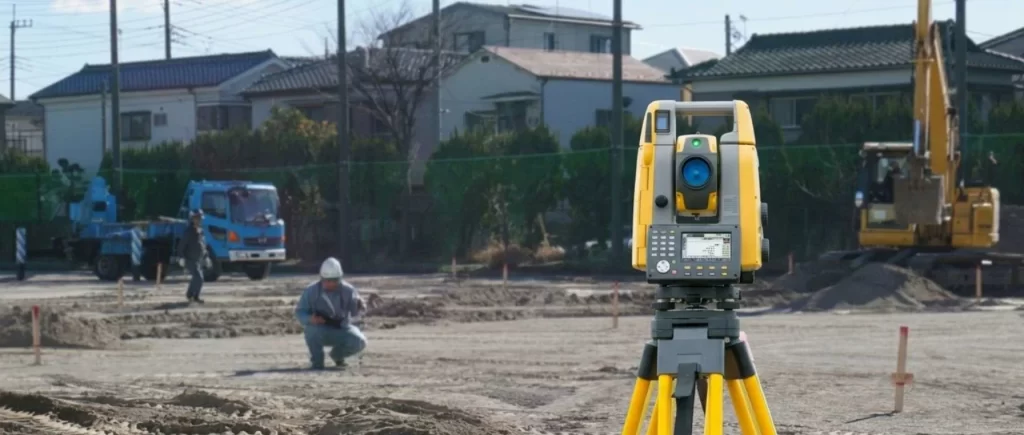
What is a Total Station?
- Electronic Theodolite: Measures both horizontal and vertical angles with high precision.
- Electronic Distance Meter (EDM): Sends out a laser beam to a target (either a reflective prism or a physical surface) and calculates the exact distance based on the reflection.
- Microprocessor / Data Collector: Acts as an on-board computer. It instantly processes raw measurements to calculate exact 3D coordinates (\(X, Y, Z\)) and elevations relative to a fixed point.
Main Components of a Total Station
1. Telescope-Aiming and targeting of points. Highly effective viewing.
2. Electronic Distance Measurement (EDM)-Electronic measurement of the distance by infrared or laser beams. Calculation of both horizontal and inclined distances.
3. Angular Measurement System –Electronic measurement of both vertical and horizontal angles. Based on highly precise digital encoders.
4. Control Panel & Keypad-Entering data, controlling the instrument. Providing function keys and control buttons.
5. Display Screen-Measurement and data display. Color touch screen is common in modern models.
6. Microprocessor & Data Storage-Measurement calculations. Data and coordinates storage.
7. Battery-Power supply unit. Rechargeable lithium ion batteries most common.
8. Tribrach and Leveling-Leveling of the device and its mounting. Includes foot screws, electronic/bubble levels.
9. Optical/Laser Plummet-Precise centering of the device above the point of interest.
10. Communication Module-Transferring data. Connecting with field controller and survey software.
How Does a Total Station Work?
The principle of a Total Station includes the determination of:
Angle (horizontally)
Angle (vertically)
Distance (slope)
The distance is determined through an EDM beam which reflects off a prism and back to the Total Station, which then calculates the precise distance.
Through complex trigonometric operations, the Total Station automatically computes:
- X-coordinates (Easting)
- Y-coordinates (Northing)
- Height (RL) of each point
- Area
- Volume
Thus eliminating any need for manual computations.
Types of Total Stations?
Various types of Total Stations include:
1. Manual Total Station– In which an individual will aim and determine the survey points manually.
Advantages:
Affordable
Easy to maintain
Ideal for small-scale surveys
2. Robotic Total Station– An instrument that can target and follow the prism with a surveyor alone.
Advantages:
One person only needed
Increased productivity
Greater accuracy
3. Reflectorless Total Station- Determine distances without the need for a prism.
Advantages:
More efficient
For difficult-to-reach sites
Increased safety
4. Imaging Total Station- Total Station with cameras to take site photos simultaneously.
Advantages:
Visual documentation
More thorough site surveys
Improved reporting facilities
Applications of Total Station?
Boundary surveys, topographical surveys, and cadastral surveys.
Construction Surveying
For setting out of foundation, columns, roadways, and utility systems.
Highway Surveying
For route selection, earth work and roadway design surveys.
Mine Surveying
Calculating volumes of mines and conducting mine surveys.
Railway Surveying
Conducting rail tracks surveys.
Underground Utility Surveying
Conducting pipeline surveying and surveying for underground utilities.
Structural Surveying for Deformations
Surveying of bridges, dams, and skyscrapers.
Advantages of Using a Total Station?
Efficiency
Time is saved during surveys.
Data Digitization
Elimination of transcription errors in manual transcription of data.
Increased Efficiency
Due to automatic computation and coordinate generation.
Versatile Application
For different types of surveys such as construction, mining, civil engineering and surveying.
Data Transferability
For transferring survey data into another computer software.